Dr. Storms' Activated Palladium Method: Boosting LENR Reliability
Introduction: Advancing LENR Reliability with Activated Palladium
Low Energy Nuclear Reactions (LENR), often referred to as "cold fusion," represent a frontier in clean energy research. Unlike conventional nuclear power, LENR promises energy generation without harmful radiation or long-lived waste. However, one of the primary hurdles has been the challenge of consistently reproducing the effect. Recent insights from Dr. Edmund Storms, a long-standing and respected researcher in the field, offer a significant step forward in addressing this critical issue.
Dr. Storms' Method for Reliable Cold Fusion
Dr. Storms has developed a specific method for preparing palladium samples that reliably produce the cold fusion effect with a high success rate. The core of his innovation lies in distributing finely divided, inert calcium oxide (CaO) particles throughout the palladium metal. Storms postulates that these embedded particles are essential catalysts or facilitators for triggering the low energy nuclear reactions. His work directly addresses the variability that has plagued LENR experiments for decades, by providing a repeatable and effective material preparation technique. A detailed video demonstrating this process, showcasing Dr. Storms' meticulous approach to making activated palladium, is available through the LENR-CANR library of papers.
Implications for LENR Buyers and Early Adopters
The Quest for Reproducibility
For potential buyers and early adopters of LENR technology, reproducibility and reliability are paramount. The promise of clean, abundant energy is compelling, but without consistent performance, commercialization remains elusive. Dr. Storms' method marks a crucial advancement because it demonstrates a pathway to achieve predictable results, transforming an often sporadic phenomenon into a more controllable process. This consistency is vital for scaling up research and moving towards practical applications.
What This Means for Commercial Devices
This breakthrough suggests that future LENR devices could incorporate such specially prepared palladium, leading to more stable and predictable energy output. For manufacturers, understanding and implementing this material science innovation will be key. It could accelerate product development cycles and reduce the perceived risk for investors interested in this burgeoning sector. The ability to reliably initiate the LENR effect strengthens the case for its viability as a future energy source, from small-scale heat generators to compact power units.
Evaluating LENR Products
As the LENR market evolves, buyers will need to scrutinize the underlying technology and materials used. When evaluating prospective LENR devices or systems, it will be increasingly important to inquire about the methods of material preparation, particularly concerning palladium. A product utilizing a proven, reliable activation method like Dr. Storms' could offer a distinct advantage in performance and longevity, providing a more robust return on investment for early adopters.
Conclusion: A Step Towards Practical LENR
Dr. Storms' work on activated palladium represents a vital contribution to the LENR field, offering a credible and reproducible path forward. This development not only bolsters scientific understanding but also paves the way for the design and eventual commercialization of reliable LENR power solutions. It brings the vision of clean, abundant energy a significant step closer to reality.
Related Articles

Edmund Storms' Cold Fusion History: An Anticipated LENR Perspective
Anticipate a unique historical deep-dive as LENR pioneer Edmund Storms shares his authoritative perspective on cold fusion in an upcoming LENR News feature.
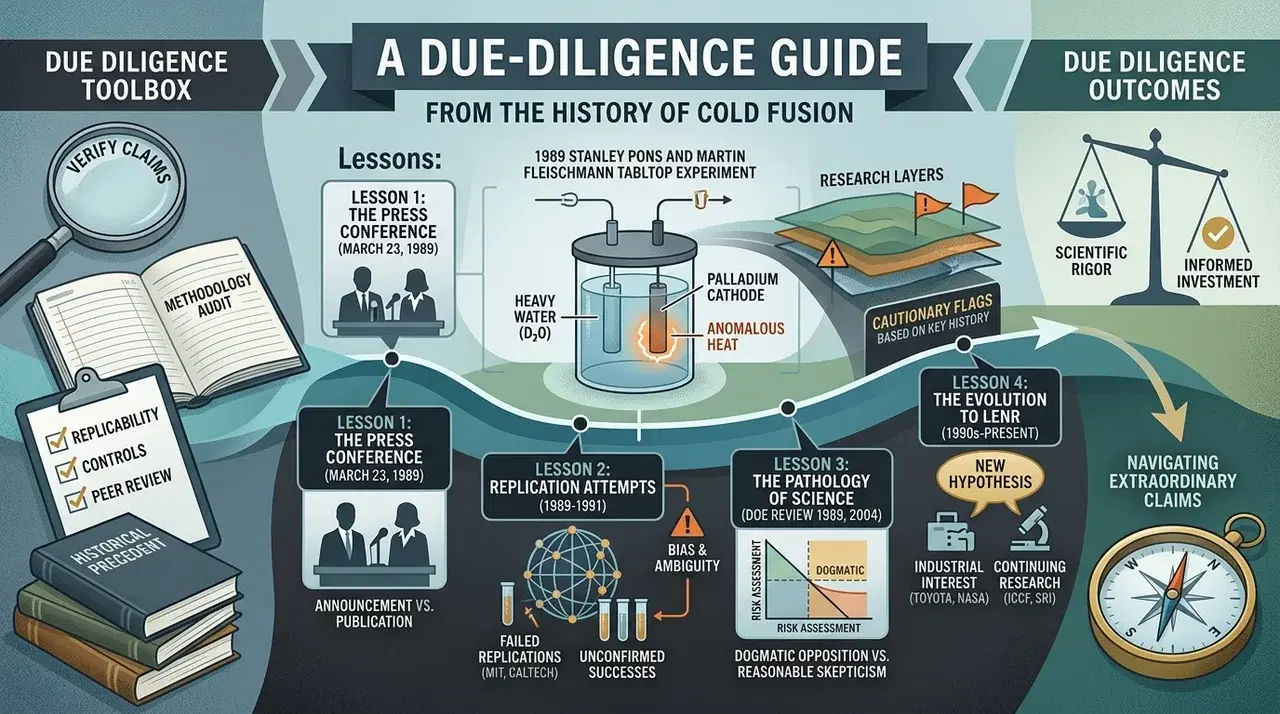
Buying an emerging technology: A Due-Diligence Guide from the History of Cold Fusion
For as long as people have claimed to sell devices that produce more energy than they consume, the claims have shared a recognisable shape. A buyer does not need to adjudicate the underlying physics — a question the scientific community itself has not closed — to protect themselves. They need to ask the questions that skeptics and disappointed investigators have been asking since the [[Fleischmann-Pons announcement]] of March 1989. This guide distils those questions into a due-diligence framework drawn entirely from the historical record: how excess-energy *measurements* go wrong, what independent *reproduction* actually requires, what a hollow *demonstration* looks like, and what past *commercial* devices teach about the gap between a showroom and a working product.
LENR Ontology Update v8: Standardizing Cold Fusion Research
A significant update to the "Corrected Ontology related to Cold Fusion" (v8) marks a crucial step towards standardizing LENR research and accelerating development.