Buying an emerging technology: A Due-Diligence Guide from the History of Cold Fusion
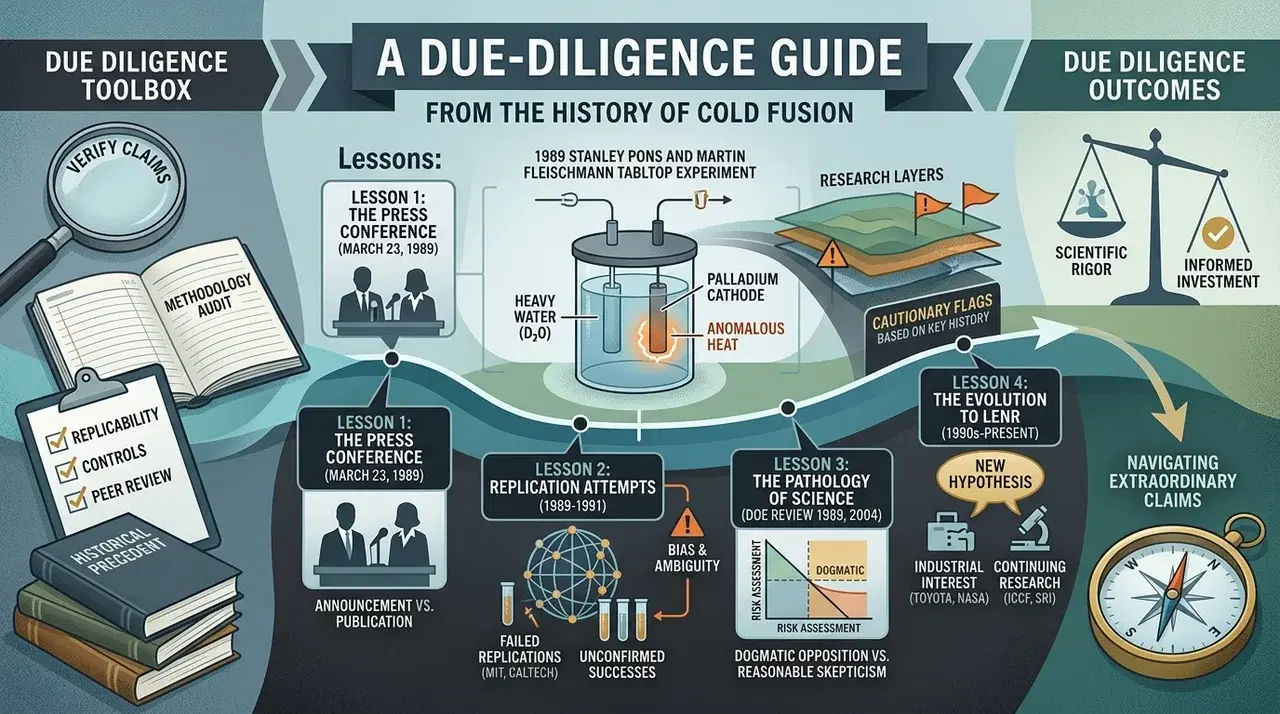
1. The measurement is the product — so scrutinise the measurement
In LENR, the claimed product is heat, and heat is measured by [[calorimetry]]. Because the claimed anomalies are often only a few percent to a few tens of percent above input power, the entire question of whether a device "works" collapses into whether the calorimetry is trustworthy.1 The archive is a catalogue of how it fails:
- Mis-wired or mis-placed thermometers. [[Frank Close]] documented how Texas A&M's early excess-heat signal was traced to a mis-earthed thermometer, and Georgia Tech's apparent neutrons to a temperature-sensitive [[BF3 counter]] — both vanished on careful examination.2
- Uncorrected recombination heat. When electrolytically evolved [[deuterium]] and [[oxygen]] recombine, they release chemical energy that can masquerade as nuclear heat. Credible work seals the cell, uses an internal recombiner, or otherwise accounts for this pathway; early claims that did not were rightly discounted.3
- Coefficient-of-performance theatre. A reported COP greater than 1 ("[[over-unity]]") means nothing without the controls above. The new-energy literature is full of dramatic ratios — output-to-input figures cited as high as 70,000:1 — presented as proof, with the calorimetric caveats omitted.4
Buyer's questions. What kind of calorimeter? Is there a blank or light-water control run that shows no excess? Is recombination sealed off or measured? Is the input power (including any pulsed or RF drive) fully accounted for? A seller who cannot answer these is selling a number, not a measurement.
2. "It works in our lab" is not reproducibility
The methodological heart of the controversy is [[reproducibility]], and the corpus draws a sharp line a buyer should memorise. There is a difference between a device that an experienced team can coax into producing an effect in its own laboratory, and a device that an independently constituted team, following a published protocol, can confirm. The latter is the scientific gold standard — and the archive records that no cold-fusion result met it during the period it covers.5
This matters commercially because the demonstrations that sell devices are almost always of the first kind. Proponents have long argued, plausibly, that the effect is real but hypersensitive to materials and preparation; skeptics reply that a phenomenon you cannot hand to a stranger with instructions is not yet a product.6 Either way, the buyer's protection is the same.
Buyer's question. Has a party with no financial stake, using their own instruments, reproduced this from written instructions? If the only successes are in the seller's hands or the seller's lab, treat the demonstration as a marketing event, not evidence.
3. Demonstration is not evidence — the E-Cat as the defining case
The most commercially prominent LENR episode, the [[E-Cat and Rossi era]], is the textbook illustration of the demonstration trap. From [[Andrea Rossi]]'s January 2011 [[Bologna]] demonstration onward, credentialled observers reported anomalous heat, an ecosystem of licensing companies formed around the device ([[Defkalion Green Technologies]], [[Ampenergo]], [[Hydrofusion]], [[Industrial Heat LLC]]), and a one-megawatt plant was shown — yet no fully independent test ever verified the claims under unambiguous conditions where the inventor did not control the setup.7 Even the most-cited favourable report, by physicists [[Sven Kullander]] and [[Hanno Essén]], was an observation of a Rossi-run test, not an independent replication.8
The lesson is not that Rossi was right or wrong — the corpus leaves that unresolved — but that years of demonstrations, company formations, and press coverage accumulated without ever converting into the one thing a buyer needs. Volume of attention is not weight of evidence.
4. Three cautionary purchases
The archive records devices that looked buyable and were not:
- The [[Patterson Power Cell]] (CETI, mid-1990s). Publicly demonstrated at a 1995 power-industry conference, promoted with claims of heat output "1000% above electrical power input" and "near-100% reproducibility," and the closest the field came to a commercial product. It generated headlines, then faded without delivering a verified, saleable energy device.9
- The [[Rory Johnson cold fusion motor]] (Magnatron, 1978). A "525-horsepower" motor demonstrated through a showroom window to a Greyhound evaluator, with a 1,400-hp bus version promised. It was never independently examined, produced no technical documentation, and the company was closed by court order under unexplained circumstances. It survives in the corpus as a cautionary curiosity.10
- The [[Richter affair]] (Argentina, 1951). Not a sale but the archetype: a physicist announced controlled fusion three weeks into the work, with no independent examination and no peer review, backed by political enthusiasm; a successor government found the enterprise fraudulent. The corpus pairs it with the British ZETA episode of 1958 as the standing warning about announcements driven by enthusiasm rather than verification.11
5. The pattern: a red-flag checklist
The recurring warning signs across these cases line up almost exactly with the criteria for [[pathological science]] set out by Nobel laureate [[Irving Langmuir]] and applied to cold fusion by [[Douglas Morrison]] of [[CERN]].12 Reframed for a buyer:
- The effect lives at the edge of detectability — it needs the seller's special instruments or analysis to see at all.
- Output doesn't scale with input in any stable, predictable way.
- Extraordinary precision or performance is claimed without commensurate error analysis.
- The mechanism is "not fully understood yet" but the product is somehow ready to sell.
- Every criticism is met with a new ad hoc excuse rather than an open test.
- The supporters are enthusiasts, not independent experts — and independent interest fades rather than grows.
Two behavioural flags from the record round this out: legal threats against skeptics (an attorney for [[Stanley Pons]] once threatened the physicist [[Michael Salamon]] over a null-result paper), and opaque money (the "anonymous donor" scandal that helped sink the [[National Cold Fusion Institute]]).13 A seller who reaches for lawyers or hides their backers is telling you something.
6. Before you buy — a one-page test
Ask the seller, and require documents, not assurances:
- Measurement: Calorimeter type? Blank/control runs? Recombination and full input power accounted for?
- Independence: A no-stake third party, own instruments, written protocol — has anyone reproduced it?
- Evidence vs. demo: Is the proof a peer-reviewed/independent result, or a demonstration the seller controls?
- Track record: Are there prior unfulfilled promises, vanished products, or company dissolutions in the principals' history?
- Conduct: Transparency about funding and method, or lawyers and ad hoc excuses?
If the answers aren't there, the historical odds — three-plus decades of them — say keep your money.
Notes
Footnotes
-
On calorimetry as the experimental backbone of LENR and the few-percent magnitude of typical claims, see [[Calorimetry]], synthesising [[Eugene F. Mallove]], Fire from Ice (1991), Pts. 3, 6, 9, 11, 14, and Tadahiko Mizuno, Nuclear Transmutation: The Reality of Cold Fusion (1998), Pt. 5. ↩
-
[[Frank Close]], Too Hot to Handle: The Race for Cold Fusion (Penguin, new ed. 1992), Pt. 13: Texas A&M excess heat traced to a mis-earthed thermometer; Georgia Tech neutron signal from a temperature-sensitive [[BF3 counter]]. See [[Over-unity]]. ↩
-
On recombination heat as a calorimetric artefact and the sealed-cell / internal-recombiner controls used to exclude it, see [[Calorimetry]], synthesising Mallove, Fire from Ice, Pts. 3 and 6 (the [[Robert Huggins]] nitrogen-glovebox and light-water-control protocol at [[Stanford University]]). ↩
-
Antony C. Sutton, Cold Fusion: The Secret Energy Revolution (1999), Pts. 1–2, characterising the field as "over-unity" and citing output-to-input ratios up to 70,000:1; with the sceptical reading (calorimetric artefacts, publication bias) in Close, Too Hot to Handle. See [[Over-unity]]. ↩
-
[[Reproducibility]], synthesising Mallove, Fire from Ice, Pts. 6, 9, 11, and The Rebirth of Cold Fusion (Krivit & Winocur, 2004), Pt. 1: the distinction between within-laboratory reproduction by experienced practitioners and confirmation by an independently constituted team following a published protocol, the latter unmet in the corpus period. ↩
-
The proponent case (hypersensitivity to [[palladium]] preparation and [[deuterium]] loading, D/Pd > 0.85) versus the sceptical "reproducible-on-demand" standard, per [[Reproducibility]] and the Santa Fe workshop formulation of [[Paul Chu]] and [[John Appleby]] (1989). ↩
-
[[The E-Cat and Rossi Era]] and [[Andrea Rossi]], synthesising [[Mats Lewan]], An Impossible Invention: The True Story of the Energy Source That Could Change the World (Stockholm: Vulkan, 2014): the 14 January 2011 [[Bologna]] demonstration, the surrounding companies ([[Defkalion Green Technologies]], [[Ampenergo]], [[Hydrofusion]], [[Industrial Heat LLC]]), the one-megawatt plant, and the absence of a fully independent verification under uncontrolled-by-inventor conditions. ↩
-
Lewan, An Impossible Invention, Pts. 5–6: the 29 March 2011 test observed by [[Sven Kullander]] and [[Hanno Essén]], whose report ruled out a chemical explanation for the measured energy but was an observation of a Rossi-operated test rather than an independent replication. ↩
-
[[Patterson Power Cell]], synthesising [[Fusion Facts]] (November 1995) on the PowerGen Anaheim demonstration and the [[ICCF-6]] (1996) paper by [[James Patterson]], John Nix, [[Dennis Cravens]], and [[George Miley]] et al. claiming heat output "1000% above electrical power input" and near-100% reproducibility. ↩
-
[[Rory Johnson cold fusion motor]], from Gerald Orlowski's first-hand review in [[Fusion Facts]] (August 1993): the December 1978 Chicago demonstration, the 525-hp and promised 1,400-hp ratings, the absence of independent examination or documentation, and the court-ordered closure of Magnatron. ↩
-
[[Richter affair]], synthesising Close, Too Hot to Handle, Pt. 3, and Mallove, Fire from Ice, Pt. 3: [[Ronald Richter]]'s 1951 Argentine fusion claim, announced without independent examination or peer review and later found fraudulent; paired in both books with the British ZETA episode (1958) as cautionary precedents. ↩
-
[[Pathological science]], synthesising Mallove, Fire from Ice, Pt. 15, and Close, Too Hot to Handle: [[Irving Langmuir]]'s six criteria (reprinted in Physics Today, October 1989) and their application to cold fusion by [[Douglas Morrison]] of [[CERN]]. The reframing here is adapted for prospective buyers; proponents (notably Mallove) contested the label's fairness, a dispute preserved on that page. ↩
-
The [[Stanley Pons]] attorney's threat against [[Michael Salamon]] over a null-result Nature paper (Mallove, Fire from Ice, Pt. 13; Close, Too Hot to Handle) and the "anonymous donor" episode at the [[National Cold Fusion Institute]] (Mallove, Fire from Ice, Pts. 5 and 13). ↩
Related Articles

LENR Ontology Update v8: Standardizing Cold Fusion Research
A significant update to the "Corrected Ontology related to Cold Fusion" (v8) marks a crucial step towards standardizing LENR research and accelerating development.

Open LENR 1: Community-Driven Cold Fusion Research
Explore 'Open LENR 1,' a Reddit discussion potentially signaling a collaborative push for accessible, open-source Low Energy Nuclear Reactions. What does this mean for clean energy?
E-Cat Deliveries Underway for Megawatt Plant: What Buyers Need to Know
Andrea Rossi reports E-Cat units are being delivered for a megawatt-scale electricity plant. This step marks progress for LENR, but critical details remain undisclosed for potential buyers and investors.