Andrea Rossi Secures 2025 Patent for Vacuum Diode Power Supply
Latest Breakthrough: Rossi's 2025 Patent Unveiled
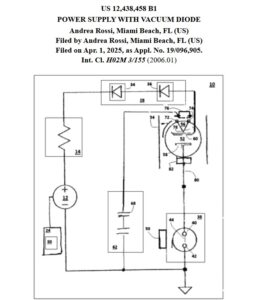
Andrea Rossi, a prominent figure in the realm of Low-Energy Nuclear Reactions (LENR), has recently been granted a U.S. patent in 2025 for a "Power Supply With Vacuum Diode." This development, highlighted by E-Cat World, indicates continued research and legal protection surrounding his innovative energy concepts, notably the Energy Catalyzer (E-Cat) technology.
Understanding the "Power Supply With Vacuum Diode"
The patent focuses on a "Power Supply With Vacuum Diode," suggesting advancements in the electrical and control systems vital for his LENR devices. While specific details require reviewing the full patent document, the title implies a system designed to regulate and deliver power, likely optimizing conditions for the LENR effect within Rossi's inventions. Granting a patent provides legal protection for a specific invention, signifying that it has been deemed novel, non-obvious, and useful by the U.S. Patent and Trademark Office. It's a key step in intellectual property protection.
LENR and E-Cat: A Brief Overview
For those unfamiliar, LENR describes a class of proposed nuclear reactions occurring at low energy levels, purportedly producing excess heat without harmful radiation. Andrea Rossi rose to prominence with his E-Cat device, claiming it generates substantial clean energy. The LENR field is marked by both strong advocacy and scientific skepticism due to challenges in consistent replication and a lack of widely accepted theoretical understanding.
Implications for LENR Buyers and Early Adopters
The granting of this new patent carries several implications for potential buyers and early adopters of LENR technology:
Patent vs. Product Readiness
A new patent indicates ongoing innovation and strategic intellectual property protection for elements of Rossi's E-Cat system. However, it's crucial to understand that a patent is a legal instrument, not a certification of commercial readiness or scientific validation. It protects an invention but doesn't confirm its market viability or the broad scientific acceptance of its underlying principles. This patent underscores continued development but does not equate to a market-ready product.
Essential Due Diligence for Buyers
For prospective buyers considering future LENR products, including any potential E-Cat devices, diligent research remains paramount. Key questions to address include:
- Commercial Availability: Is the patented technology integrated into a product currently available for purchase?
- Independent Verification: Have claims of energy output, efficiency, and safety been independently verified in repeatable, transparent studies by reputable third parties?
- Practical Application: What are the projected costs, scalability, and suitability for real-world applications?
While a patent adds to the ongoing narrative, buyers should prioritize clear product demonstrations, robust independent validations, and well-defined commercialization paths before making investment decisions in this still-developing energy sector.
Related Articles

Rossi's E-Cat NGU: 1MW Heat Plant Marks Key LENR Step
Andrea Rossi announces the first E-Cat NGU plant producing 1 MW of heat, signifying a crucial validation phase. We explore the implications for the LENR market.
Rossi's E-Cat: Megawatt SSM Focus & Market Realities
Andrea Rossi indicates E-Cat's Self-Sustain Mode (SSM) is currently viable only for megawatt plants, citing a 5% failure rate for smaller units. This shifts focus for LENR applications.

E-Cat Pre-Orders: Rossi Projects 2026 Deliveries, Cautions on Home Use
Andrea Rossi believes E-Cat pre-order deliveries may begin in 2026, though technical challenges for household integration persist. We explore implications for the LENR community.