Biaco Energy Secures Funding for Innovative Plasma Technology Trials
Biaco Energy Secures Funding for Innovative Plasma Technology Trials
At LENR Buyer Guide, we keep a vigilant eye on all emergent energy technologies poised to disrupt traditional paradigms and offer sustainable alternatives. While Low Energy Nuclear Reactions (LENR) remain our primary focus, we recognize the broader landscape of advanced energy systems that promise a revolutionary low-carbon future. It is within this context that we highlight Biaco Energy's recent announcement: securing funding through Innovate UK’s ADOPT programme to trial its innovative plasma technology.
This development, while not explicitly labeled as LENR, presents a compelling vision for decarbonization and resource efficiency that directly aligns with the aspirations of our community. Biaco's system is being put to the test in a 12-month program with key partners Vitacress Herbs, Vitacress Salads, and West Sussex Growers, aiming to tackle critical challenges in controlled-environment agriculture.
A Dual-Challenge Solution: Energy and Water
Biaco Energy's project addresses two major pain points for the horticulture industry:
Decarbonizing Greenhouse Heating
The first phase involves installing a Biaco prototype heating system at Vitacress Herbs’ greenhouse site in Runcton. The goal is to supply a significant portion of the site’s heating demand, demonstrating a lower-carbon alternative to existing fossil fuel-based technologies, such as natural gas-powered Combined Heat and Power (CHP) engines. For investors, this represents a potential market for scalable, sustainable heating solutions, while for ecologists, it's a direct step towards reducing agricultural carbon footprints.
Sustainable Water Treatment and Reuse
The second, equally impactful phase applies Biaco’s plasma technology to liquid waste processing. Salad wash water from Vitacress Salads will be treated to break down residual pesticides and fertilizers. This is a game-changer for water sustainability, potentially enabling water reuse and significantly reducing the environmental impact of agricultural runoff. Preppers and off-grid enthusiasts will recognize the immense value of efficient water purification and recycling, critical for self-sufficiency.
Implications for the LENR Buyer Guide Community
While Biaco’s plasma technology operates on different physical principles than the nuclear processes explored in LENR, its ambitious goals resonate deeply with our audience:
- For Investors: This trial showcases a practical application of advanced energy technology addressing tangible, immediate market needs in agriculture. The potential for widespread adoption in a carbon-intensive sector could offer significant returns if successful.
- For Researchers and Technologists: The phrase “revolutionary low carbon energy system” is a call to attention. While not LENR, understanding how other advanced energy systems achieve efficiency and tackle real-world problems can offer valuable insights and potential points of convergence in materials science, control systems, or energy transfer mechanisms.
- For Preppers and Off-Grid Enthusiasts: Reliable, low-carbon heating and advanced water treatment are foundational to resilient living. Should this technology mature, it could integrate into sophisticated off-grid setups, providing critical utilities with minimal environmental footprint.
- For Ecologists and Clean Energy Advocates: Biaco’s project is a clear win for sustainability, promising reduced emissions and improved water resource management. It offers a tangible example of how innovative technology can directly address climate change and environmental degradation.
- For Hobbyists and Experimenters: While a prototype system, tracking such developments helps us all understand the practical challenges and deployment strategies for novel energy solutions beyond the lab.
Our Take: Optimism with Measured Observation
At LENR Buyer Guide, we approach such announcements with characteristic optimism for transformative potential, tempered by a commitment to rigorous honesty. Biaco Energy’s plasma technology offers a compelling vision for decarbonized agriculture and improved water sustainability. The Innovate UK funding and collaboration with established agricultural partners lend significant credibility to the trial.
However, as of 2026, this remains a prototype trial. We eagerly await the results of the 12-month program to assess its demonstrated performance, safety, cost-effectiveness, and scalability in real-world conditions. We will continue to monitor Biaco Energy's progress, recognizing that the journey to a truly low-carbon future involves a diverse portfolio of advanced energy solutions, each with its unique role to play.
References:
Related Articles
State of LENR Commercialization 2025
This report provides an expert-level evaluation of the Low Energy Nuclear Reaction (LENR) field, anticipating a pivot from research to commercialization between 2025 and 2026.
Buying an emerging technology: A Due-Diligence Guide from the History of Cold Fusion
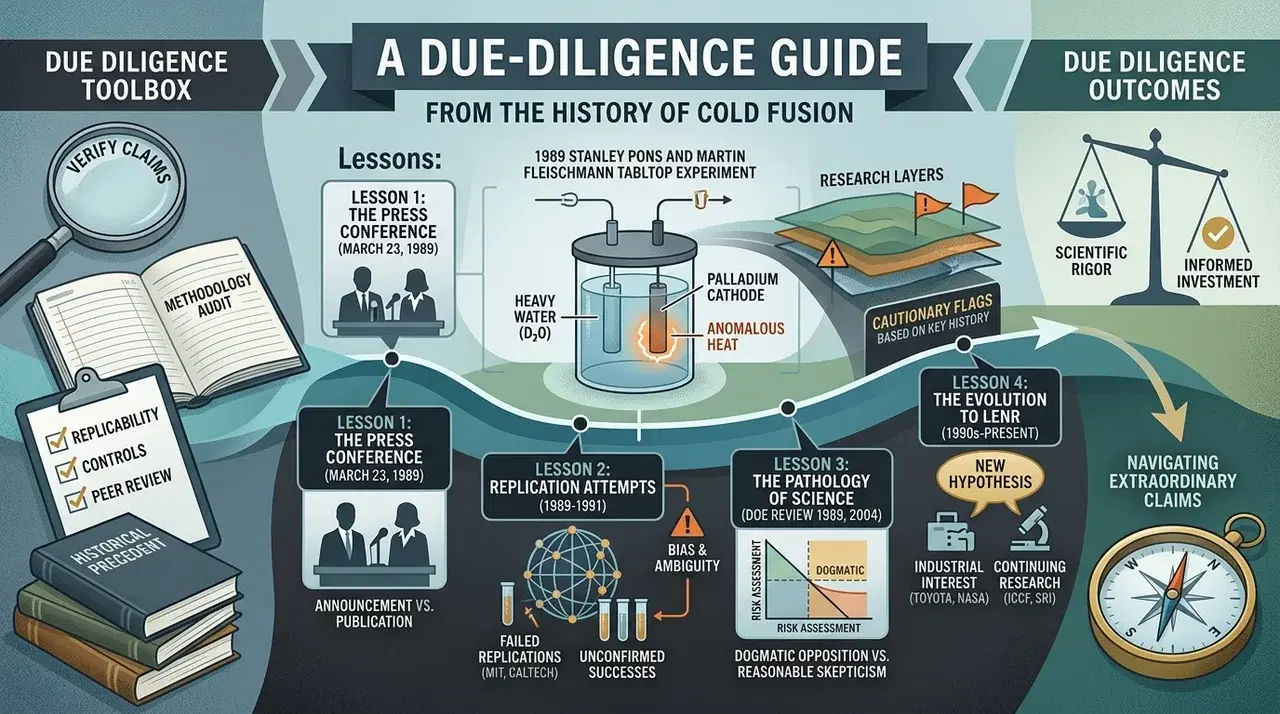
For as long as people have claimed to sell devices that produce more energy than they consume, the claims have shared a recognisable shape. A buyer does not need to adjudicate the underlying physics — a question the scientific community itself has not closed — to protect themselves. They need to ask the questions that skeptics and disappointed investigators have been asking since the [[Fleischmann-Pons announcement]] of March 1989. This guide distils those questions into a due-diligence framework drawn entirely from the historical record: how excess-energy *measurements* go wrong, what independent *reproduction* actually requires, what a hollow *demonstration* looks like, and what past *commercial* devices teach about the gap between a showroom and a working product.
Cold Fusion: The Early Years (1989–1991)
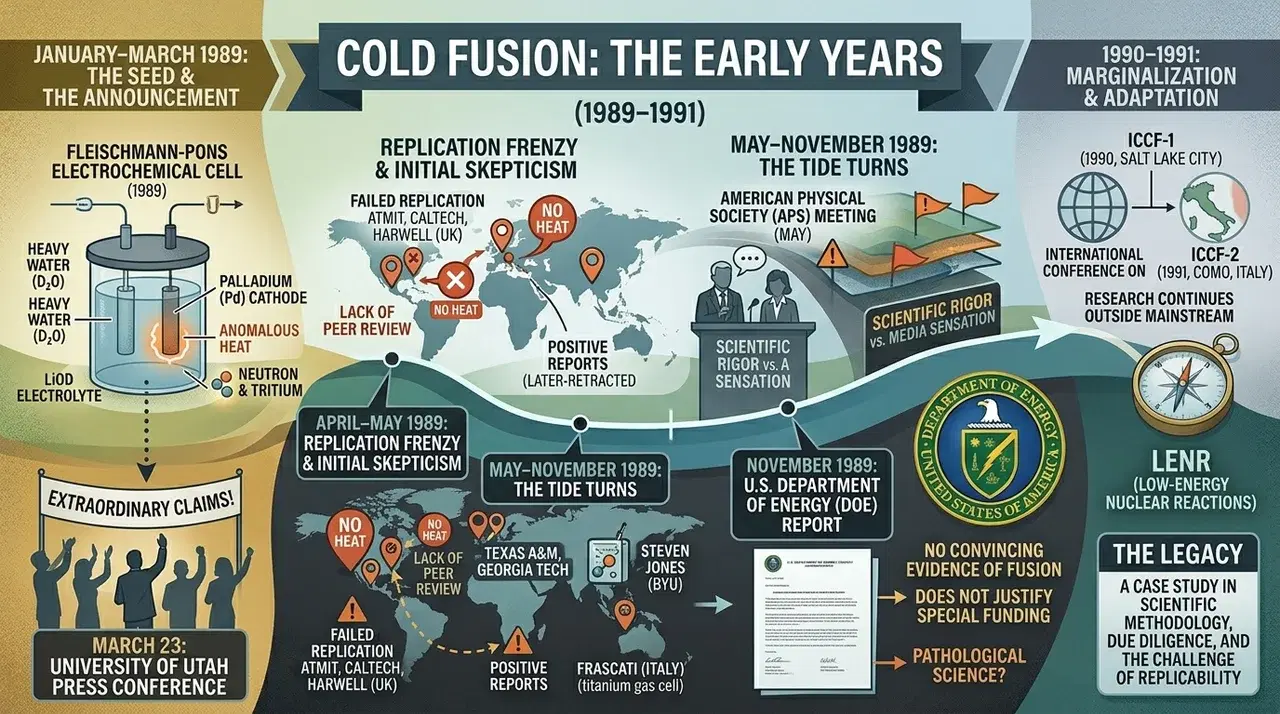
The story does not begin in 1989 but some five years earlier, in the private and largely self-funded work of two electrochemists. [[Martin Fleischmann]], approaching sixty-two, was a Fellow of the Royal Society and one of the most respected electrochemists of his generation, a professor at the [[University of Southampton]]. [[Stanley Pons]], forty-six, chaired the chemistry department at the [[University of Utah]] and had taken his doctorate under Fleischmann at Southampton.